

There’s a big difference between camping off-grid and camping unprepared. When I first started solo camping in places across California, and especially Baja California, I quickly realized that having a reliable source of power wasn’t a luxury. It was a necessity.
For charging camera gear, powering my smartphone or laptop, running lights, and keeping my other electronics going, this Jackery Explorer 1000 Portable Power Station V1 has become my go-to power station. It has also proved useful at home, especially when the power goes out.
I’ve has this for about 3 years now, and have used the Jackery extensively while camping and, most importantly, during a month-long remote camping trip through Baja Mexico. In this review, I’ll share what I like about it, how I’ve actually used it, and what you should know before buying one.
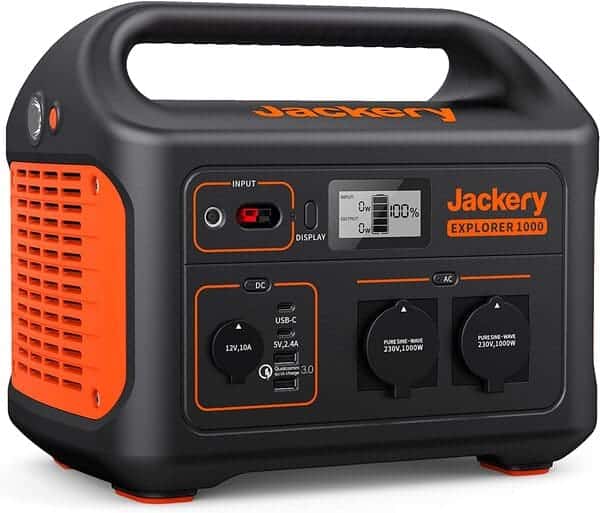
Jackery Explorer 1000 Specs at a Glance
- Battery capacity: 1002Wh lithium-ion battery
- AC output: Up to 1000W, with 2000W peak
- Ports: 3 AC outlets, 2 USB-A ports, 2 USB-C ports, and 1 car outlet
- Charging: Wall outlet, car outlet, or solar
- Weight: About 22 lbs
- Noise: Silent during normal operation
Power You Can Count On While Camping
When you’re camping in the desert or deep in the mountains, there isn’t necessarily a backup plan if your electronics die. I rely heavily on my camera, drone, GPS, smartphone, and laptop when I’m creating content for Miles & Hikes, so having dependable power is important to me.
The Explorer 1000’s 1002Wh battery gives me enough capacity to keep my essential electronics running without constantly worrying about finding an outlet. I can charge camera batteries, drone batteries, phones, lights, and other equipment, and I can also use it to power my laptop while working from camp.
Another major advantage is that it’s completely silent. Unlike a gas generator, there’s no engine noise, exhaust, or fuel to deal with. That makes a huge difference when you’re camping somewhere quiet. I can use it at night without listening to a generator running next to me, and I can charge equipment without disturbing the campsite.
That fits pretty well with the whole idea behind Leave No Trace.
My Real-World Test: Remote Filming in Baja Mexico
One of the biggest tests of the Jackery Explorer 1000 came during a month-long remote camping trip through Baja Mexico.
I was off-grid for nearly four straight weeks, often staying in remote areas without access to electrical hookups. During that trip, the Jackery kept my filming equipment charged, including drone batteries, power banks, camera equipment, and my laptop for editing.
For me, this is where the Jackery really proved its value. When you’ve driven a long way into a remote part of Baja to film something, the last thing you want is to discover that your batteries are dead.
Having a large power station in the vehicle meant I could continue filming, charging equipment, and editing content without constantly thinking about where my next source of electricity was going to come from.
I used it in places such as Agua Verde and other remote areas of Baja where access to power simply wasn’t an option. For a photographer, filmmaker, YouTuber, or anyone who spends extended periods traveling away from electrical hookups, that kind of flexibility is extremely useful.
Easy to Use, Even If You Don’t Know Much About Electricity
One thing I appreciate about the Explorer 1000 is how simple it is to operate.
I’m not someone who naturally thinks in watts, amps, volts, and all the other electrical terminology that comes with power stations. Fortunately, I don’t really need to.
You turn on the appropriate output, plug in your device, and the LCD display tells you what’s happening. You can see your remaining battery percentage as well as the amount of power being used or coming into the unit while it’s charging.
That makes it much easier to figure out how much power you have available without having to do a bunch of calculations.
How I Recharge the Jackery Explorer 1000
The Explorer 1000 can be recharged several ways, which is particularly useful when you’re traveling.
Wall outlet: You can recharge it from a standard household outlet when you’re home or have access to electricity.
Car outlet: You can recharge it while driving, which is especially useful on road trips. Rather than letting all that driving time go to waste, the Jackery can be replenishing its battery while you travel.
Solar: You can also connect compatible Jackery SolarSaga panels for off-grid charging.
The solar capability is probably my favorite feature for extended camping trips. When you’re spending several days somewhere without electricity, being able to use the sun to replenish your power supply changes the equation completely.
I’ve used solar charging while camping in Baja, and there’s something particularly satisfying about being able to generate the electricity you need right at your campsite.
Is the Jackery Explorer 1000 Portable?
At around 22 pounds, the Explorer 1000 definitely isn’t something I’d want to carry into the backcountry for miles.
But that’s not really what it’s designed for.
For car camping, overlanding, vanlife, road trips, and remote campsites where you can drive relatively close to your setup, the weight is reasonable. I can move it from my vehicle to a camping table without much trouble.
The unit has also held up well to the kind of abuse that comes with my travels. Mine has been exposed to plenty of dust, heat, and road vibration, and it has continued to work reliably.
Some of the things I’ve used it to power or recharge include:
- Smartphones
- Camera equipment
- Drone batteries
- LED lights
- Laptop
- Rechargeable camping lanterns
- Power banks
Using the Jackery as Emergency Power at Home
The Explorer 1000 isn’t just a camping tool.
During a power outage in Baja, I used mine to keep several basic things running around the house, including my modem and router, a standing fan, USB lamps, and rechargeable lanterns.
That’s one of the things I like most about having a power station. It has a purpose even when I’m not camping.
A gas generator can provide much more power for certain applications, but a battery power station has some major advantages for smaller emergency needs. It’s quiet, produces no exhaust, and can be used indoors without the ventilation concerns associated with a combustion generator.
For keeping communication devices, lights, internet equipment, and small electronics running during an outage, it can be a very useful backup.
What I Don’t Like About the Jackery Explorer 1000
No product is perfect, and there are a few things worth considering before buying one.
It’s Heavy for Backpacking
At around 22 pounds, the Explorer 1000 is firmly in the car-camping category for me. I wouldn’t want to carry it any significant distance on a hiking trip.
If you’re looking for something to take several miles into the wilderness on foot, this isn’t the type of power station I’d choose.
Solar Panels Are an Additional Expense
The solar charging capability is excellent, but the panels are an additional purchase. If you want a truly self-sufficient off-grid setup, you’ll need to factor the cost and storage of the solar panels into your budget.
It’s More Power Than Some Campers Need
The 1000Wh capacity is great for extended trips and people carrying a lot of electronics, but you may not need this much power if all you want to do is recharge a phone and a few small devices.
For a minimalist weekend camping trip, a smaller power bank may be all you need.
Is the Jackery Explorer 1000 Worth It?
For the way I travel and camp, absolutely.
The Jackery Explorer 1000 has become one of those pieces of camping gear that I don’t really think about anymore because I know it’s going to do its job. I throw it in the vehicle, take it camping, and use it whenever I need reliable power.
Its biggest advantage for me isn’t simply the amount of electricity it stores. It’s the freedom it gives me to stay somewhere longer without worrying about finding an electrical hookup.
That became particularly obvious during my month-long trip through Baja. I was able to keep my camera gear, drone batteries, laptop, phone, lights, and other equipment charged while spending weeks away from conventional power.
For someone who spends a lot of time car camping, overlanding, road-tripping, creating content, or simply wants a reliable backup power source at home, the Explorer 1000 has been an excellent fit for me.
Would I buy it again? Yes.
After years of using it and putting it through extended trips, remote camping, heat, dust, and plenty of road miles, the Jackery Explorer 1000 remains one of my favorite pieces of camping gear.
Want to See More Gear?
Wondering what gear is actually worth taking on the road? Check out my gear page for the equipment I use for hiking, camping, fishing, road trips, and exploring.