There is something about an abandoned place that makes me want to stop the car and jump out. Sometimes it is obvious from the road: a crumbling adobe building, an old mining structure, or an entire settlement slowly disappearing into the desert. Other times, it is something much smaller—a strange road leading somewhere it shouldn’t, a foundation hidden in the brush, or a building that looks completely out of place. But what interests me most isn’t really the ruin itself. It is the evidence that people were there. A bed left in an empty room. An old radio. A child’s toy. Cans still sitting in a pantry. A broken tea cup. A shoe. These ordinary things make it possible to imagine what life was like before the place was abandoned, and that is what makes exploring Baja’s forgotten places so fascinating to me.
Over the years, I’ve come across quite a few of them. Some were once mining towns built around gold or onyx. Some were ranches and agricultural communities. Some were missions dating back more than two centuries. And one was a village that people didn’t leave because the town’s economy failed—they left because the water came.
This is LOST BAJA. Here are twelve abandoned, forgotten, or disappearing places I’ve explored across Baja California, Mexico.
La Poza Grande — A Village That Was Forced to Move
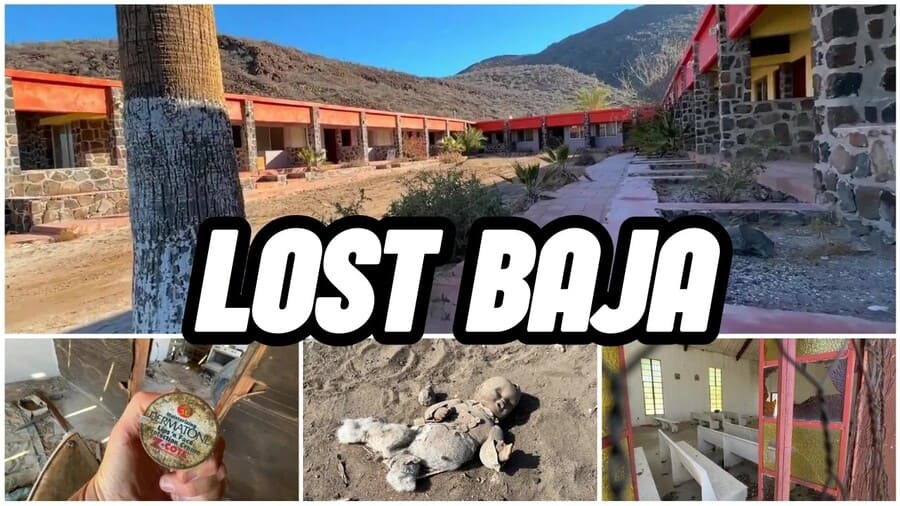
La Poza Grande is one of the most memorable abandoned places I’ve visited because of how recently people were actually living here. Walking through the old settlement, you can still see evidence of an ordinary community: houses, a tortillería, a school, a church, and even children’s toys.
But the reason the town was abandoned wasn’t a mine running out or an industry disappearing. It was water. In September 2006, Hurricane John crossed the Baja California peninsula and brought extraordinary amounts of rain to the region. Runoff from the Sierra de la Giganta caused the arroyo beside La Poza Grande to rise dramatically, eventually flooding the settlement. The lower part of the community had to be abandoned, and residents moved to higher, safer ground. The church survived because it was situated on higher ground. Everything else tells a much more personal story.
Walking through the flooded and abandoned homes, I found things that were completely ordinary when people were living here but feel strangely significant now. A ragged teddy bear. The remains of a home. A building that had once been a tortillería. These aren’t historical artifacts in the traditional sense. They’re just pieces of everyday life. But that’s exactly what fascinates me. When I walk into an abandoned building, I always find myself trying to imagine what it looked like when someone was actually living there. Who slept here? Who cooked here? Where did the kids play? What did a normal Tuesday look like?
At La Poza Grande, those questions feel particularly powerful because the people who lived here didn’t simply watch their town slowly disappear. A major weather event forced them to leave almost overnight.
On the way out, I also came across an old rural school and another abandoned church, adding even more reminders that this was once a functioning community.
The Buenaventura Hotel by the Sea of Cortez — A Hotel Frozen in Time
Driving south toward Loreto, I was heading down Highway 1 when something caught my eye on a curve in the road. An abandoned hotel. My ruins radar went off immediately!
I pulled over and walked onto the property, and what I found was much more intact than I expected. The rooms were still there, with beds and dressers sitting inside. Books and pictures remained on the walls. In what appeared to have been the administrative office, there was even an old computer and a floppy disk among the abandoned office equipment. It felt strangely frozen in time. I could almost imagine the place operating normally and then, at some point, simply being left behind.
I haven’t been able to establish exactly when the hotel closed or why it was abandoned, so I’m not going to guess. Based on the decor and the computer equipment, my initial impression was that it might date from around the 1980s, but that’s only an impression, not a documented date.
What makes the mystery even more interesting is the location. The hotel is within walking distance of Bahía Concepción, one of the most beautiful stretches of coastline in Baja. Standing there, looking at an abandoned hotel in such an incredible location, I couldn’t help asking the obvious question: how does a place like this end up abandoned? There are plenty of places in the world where a hotel with this kind of setting would probably be worth a fortune. Yet here it sits, empty, with the desert ans sea slowly taking it back.
I still don’t know the complete story of this place. And honestly, that’s part of what makes it memorable.
El Pozo Alemán & El Arco — A Town Built on Gold and Copper
Some abandoned places are mysterious. Others were created for one very specific reason. El Pozo Alemán was built around mining, and the remains of the settlement still give you a sense of the people who once lived and worked here.
The town is now privately owned by the Villavicencio family, and it feels very much like a ghost town. One of the strangest features is the series of dugouts carved into the sandstone. In a region where the summer heat can be brutal, these provided shelter from the sun.
While visiting El Arco, a town about 3 miles from El Pozo Alemán, I also heard a much darker story from a local: that miners were essentially slaves and were locked inside the dugouts at the end of their shifts. It is an incredible story, but I haven’t found reliable historical documentation to confirm it, so I think it is important to leave it where I found it—as a local account rather than established history.
There are also stories that El Pozo Alemán is haunted. Whether or not you believe that, the place is eerie enough without any ghost stories. There are old houses, the sandstone shelters, and personal objects such as vases and kitchen items scattered around the ruins. Those little objects are always what get me. A mine is easy to understand. A pile of old machinery tells you what the town was built to do. But a vase or a cooking utensil tells you about the people who lived here.
From El Pozo Alemán, I continued to El Arco to see the old mill and church. El Arco has a very interesting mining history, with gold and copper both playing important roles in the area’s story. But, unlike many of the abandoned places in this video, however, El Arco may not be finished with mining. Modern exploration and proposed development have once again put the area’s mineral resources in the spotlight. So perhaps El Arco isn’t really a ghost town at all. Its story may simply be entering a new chapter.
El Álamo — The Gold Town That Faded Away
El Álamo is another place where the landscape gives you a glimpse into Baja’s mining past. Gold discoveries in the area during the late nineteenth century helped trigger a mining boom, and El Álamo became one of the peninsula’s important gold-mining districts. Mining operations continued into the early twentieth century before the town eventually faded away.
The most impressive reminder today is the old gold mill. It is hard to stand beside a structure like that without imagining what it must have been like when it was operating. Machinery running. Workers processing ore. People arriving in town because they believed there was gold here and that the town had a future. Eventually, that future disappeared. The mill is still standing, at least in part, but the community that supported it is mostly gone.
There are other reminders of the people who lived here, too. One house has a surprisingly large swimming pool. When I first saw it, I wondered if it might have been associated with a campground, but I haven’t found enough information to say what it actually was. And again, that’s one of the things I enjoy about exploring places like this. You find something completely unexpected in the middle of nowhere and immediately start trying to figure it out. Who built this? Why? What was this place supposed to be?
Sometimes the answer is in the history books. Sometimes it isn’t.
El Mármol — A Town Built Around an Onyx Mine
El Mármol has one of the clearest stories in this collection because the reason the town existed is written directly into the landscape. Onyx.
A major onyx deposit was discovered here in 1890, and commercial mining followed soon afterward. The New Pedrara Mexican Onyx Company began operating in the area in the 1890s, and the quarry eventually became an important source of onyx for architectural and decorative use. Mining continued for decades before the quarry finally closed in 1958.
Today, almost all of the community has disappeared. But one building remains particularly striking: the old school, which was built entirely from onyx. That might be the best physical representation of El Mármol’s history. The material that brought people here also became part of the town itself.
Unfortunately, I didn’t get to spend as much time exploring as I wanted. The wind was absolutely relentless, as it can be in Baja. But even with a short visit, it was easy to see the pattern. A resource is discovered. People arrive. A community develops around it. Businesses, homes and schools appear. Then eventually the resource is no longer enough to sustain the town, and the people leave. What remains is the physical evidence of everything they built.
El Malvar — A Forgotten Agricultural Community
El Malvar is different from the classic image of a ghost town because it isn’t completely empty. A small number of people still live here. But there are also abandoned houses scattered throughout the community, giving the place the feeling of a town that is slowly fading rather than one that disappeared overnight.
I had seen El Malvar online and marked it on my map, so when I was in the area I had to stop. I explored several of the abandoned houses and found exactly the kind of things that make these places so interesting to me: pantry cans, furniture, toys and an old radio. Again, none of this is particularly valuable. But put it together and you start to get a picture of someone’s life. Someone bought that radio. Someone sat in that chair. Someone stocked those shelves. Someone’s kids played with those toys. And then, eventually, people started leaving.
I suspect the decline happened in stages rather than all at once, but I haven’t found enough reliable historical information to establish exactly when the community began to empty out or when the last residents left. That uncertainty is actually appropriate here. Not every abandoned place has a clear beginning and end. Some simply become a little quieter every year, until one day you realize that almost everyone is gone.
Rancho La Llave — An Adobe Ranch Lost to the Desert
Rancho La Llave was one of those places where I didn’t need much information to know that I had found something interesting and valuable.
The old adobe ranch is largely gone now. Only a few walls and a well remain. I would love to know exactly when the ranch was built, who lived here and how long it operated, but I haven’t found enough reliable historical information to answer those questions.
What I can tell you is what I found. Adobe walls disappearing into the desert. An old well. And, inside that well, one very large rattlesnake. That encounter was a pretty good reminder that abandoned places don’t stay empty. When people leave, something else eventually moves in. In this case, the desert—and at least one very, possibly unhappy snake.
The Abandoned Ranch — A Place We Know Almost Nothing About
Somewhere between Ejido Eréndira and Punta Colonet, I came across another abandoned ranch. This one might be the biggest mystery of the entire trip.
There are several large foundations, some with surprisingly nice tile work. From what remains, it looks as though this may once have been a fairly substantial and prosperous ranch. But beyond that, I know almost nothing.
There are broken tea cups and other small objects scattered around the property, but no obvious sign telling us who lived here or what the ranch was called. And that’s where I have to resist the temptation to create a story. It’s easy to look at a ruin and start filling in the blanks. Maybe this was a wealthy ranch. Maybe it belonged to an important family. Maybe it was abandoned after some dramatic event. Maybe none of those things are true. Without evidence, they’re just guesses.
What we do have are the foundations, the tile, the broken dishes and the incredible landscape around them. Sometimes that’s all history leaves you. A few physical clues and a lot of unanswered questions.
San Vicente — An Adobe House Left Behind
Near San Vicente, right beside the highway, I found another small group of adobe ruins. Only a couple of crumbling walls remain.
What makes this one particularly interesting is its location near Misión San Vicente Ferrer. Looking at the old adobe walls, I couldn’t help wondering whether the house might somehow be connected to the mission period. But that’s a question, not a conclusion. I haven’t found enough evidence to establish when the house was built or who lived there. I also explored the surrounding area with a metal detector and found plenty of metal objects, although most of what came up was modern trash rather than anything particularly historic. Still, even a few walls can make you stop and think about how different this landscape must have looked when these buildings were occupied. And just down the road is one of Baja’s most important mission sites, where the history is much easier to trace.
Misión San Vicente Ferrer — A Mission Left in Ruins
Misión San Vicente Ferrer is one of the stops I’ve wanted to make as part of my ongoing goal of visiting historic missions.
The mission was founded in 1780 by Dominican missionaries Miguel Hidalgo and Joaquín Valero. It became an important settlement on the Dominican mission frontier and benefited from the area’s water and agricultural potential. Like the other missions in Baja, it was much more than a church. It was a community and agricultural center, with living quarters, storage areas, kitchens, livestock and fields.
The mission system itself eventually declined as disease devastated Indigenous populations and political changes following Mexican independence made the missions increasingly difficult to maintain. San Vicente was ultimately abandoned in the nineteenth century. Today, only fragments of the complex remain.
What struck me most were the walls. They are massive, and even in their ruined state they give you an idea of how substantial this place once was. It is strange to stand in the middle of this valley looking at a few surviving walls and realize that you’re standing in a place that was established nearly two and a half centuries ago.
The buildings may be disappearing, but the location still tells part of the story. The missionaries didn’t randomly choose these places. Water, agriculture and access through the peninsula determined where communities could survive.
Velicatá — The Mission That Barely Survived
Misión San Fernando Rey de España de Velicatá takes us even farther back into Baja’s history.
This Mission was founded by Junípero Serra on May 14, 1769, during the Spanish expansion north toward Alta California. It has a particularly interesting distinction: it was the only Franciscan mission established in what is now Baja California. The mission was built at Velicatá, a place already inhabited and known to Indigenous people, and for a time it served as an important stop along the route through the peninsula.
But the mission system changed, populations declined dramatically, and missionaries eventually stopped living at Velicatá permanently.
Today, only fragments of the mission survive. A few adobe walls and foundations are enough to show where the complex once stood, but most of the original settlement has disappeared.
What I remember most about visiting Velicata, though, isn’t just the ruins. It’s the water. A river runs through the area, and seeing clear water flowing through this incredibly dry landscape immediately explains why places like this were chosen for settlements. In Baja, water changes everything. The river made it possible for people to live here, grow things and establish a community in a place that otherwise looks almost impossibly dry. We even took a bath in it.
For a few minutes, surrounded by water and desert, Velicata didn’t feel like an abandoned mission at all. It felt alive again.
Santa Catarina — A Church Left Behind
The final stop on this journey wasn’t somewhere I had planned to visit. I was driving through the area when I noticed something strange: a perfectly maintained concrete road running through what seemed like the middle of nowhere. Naturally, I followed it. Eventually, it led me to Santa Catarina, a Pai Pai Indigenous community in Baja California.
The church immediately caught my attention. From the outside, it is a beautiful little building, especially considering how isolated the community is. But inside, the atmosphere was completely different. The church was abandoned, with saints lying around inside and objects left where they had been. Then I noticed a child’s shoe. Of everything I saw in this entire journey, that tiny shoe may have been one of the things that stayed with me the most. It is such an ordinary object. But when you find a child’s shoe sitting alone inside a seemingly abandoned church, you immediately start asking questions. Who wore it? How long has it been here? Why was it left behind? I don’t know the answers. And I’m not sure anyone does.
But maybe that’s the perfect place to end LOST BAJA. Because after visiting all of these places, I’ve realized that the most interesting question isn’t always “What happened here?” Sometimes it’s simply “Who was here before me?”
The Stories Left Behind
I started this journey because I am fascinated by abandoned places. I’ll admit it. Give me a crumbling adobe building, an old mine, a forgotten hotel or a road leading somewhere that doesn’t appear to be on the map, and I’m probably going to want to investigate.
But the more of these places I visit, the less interested I become in the ruins themselves and the more interested I become in the people who left them behind. The people who slept in those beds. The families who stocked those pantries. The miners who worked the mines. The farmers who tried to make a living in an unforgiving landscape. The missionaries who established communities along the few places where water was available. The children who went to schools that are now disappearing.
Some of these places were abandoned because the gold ran out. Some because an industry disappeared. Some because people moved somewhere else. Some because nature forced them to leave. And some have stories that have simply been lost.
That’s what I love about exploring Baja. You can be driving down a road you’ve never taken before, see something in the distance and have absolutely no idea what you’re looking at. So you stop. You walk over. You investigate. And suddenly, a pile of old walls becomes a question. Sometimes you find the answer. Sometimes you don’t. Either way, you’ve discovered something.
That’s what LOST BAJA is really about. Not just abandoned buildings. Not just ghost towns. It’s about the traces people leave behind, the lives that once existed in places we might otherwise drive straight past, and the stories that are still waiting to be discovered.
Follow your curiosity.
Baja California Travel FAQ
Planning a trip to Baja California for the first time? Here are some of the questions I get asked most often, based on my own experience traveling and exploring Baja since 2011.
Is Baja California safe to travel?
In my experience, yes. I have been traveling throughout Baja since 2011, usually driving from Los Angeles, crossing the border by myself, and exploring all over Baja. I have never had an incident crossing into Mexico or returning to the United States, and I have never personally had a serious problem while traveling through Baja.
That doesn’t mean every part of Mexico is equally safe, or that nothing can ever happen. The same common sense you would use at home applies here. Don’t be flashy, pay attention to your surroundings, trust your instincts, and if a place feels wrong or unsafe, leave.
There is a lot of media coverage that can make it seem like Mexico is dangerous everywhere. Cartels and crime are real issues, but that doesn’t mean travelers are constantly encountering them. In my experience, Baja is generally peaceful and welcoming, and all of my trips have been completely uneventful.
For a more detailed look at safety in Baja, read Is It Safe to Travel in Baja California?
Is it safe to drive around Baja?
I have driven thousands of miles throughout Baja, from the border with the USA to Los Cabos and back, including on the main highways, small towns, and into remote areas.
For first-time visitors, I recommend keeping things simple: travel during daylight, stay on established routes unless you know where you’re going, and make sure you have enough fuel, water, and basic emergency supplies before heading into remote areas.
If you are going off-road, remember that many dirt roads in Baja are poorly maintained or completely unmaintained. You are responsible for being prepared for the conditions you encounter.
Should I drive at night in Baja?
Personally, I avoid it.
One of the biggest reasons isn’t even crime — it’s the roads. Animals can and do wander onto the highway, sometimes appearing directly in your path with very little warning. Cows, horses, donkeys, and other animals are a serious hazard after dark.
If you’re unfamiliar with an area, daylight also gives you much better visibility and generally means you’ll encounter more people and traffic along the way.
My advice is simple: when possible, plan your driving so that you arrive before dark.
Do I need a 4×4 to travel around Baja?
Not necessarily.
If you’re visiting popular destinations and staying on the main highways and established roads, a normal 2WD vehicle is perfectly adequate for a huge portion of Baja.
A 4×4 or high-clearance vehicle becomes much more important if you want to explore dirt roads, especially places that are far from paved highways or services. Some remote destinations, including missions such as San Borja for example, require considerably more preparation.
Always research the specific road before heading out. Conditions can change, and a road that was easy during one season can become very difficult after weather or other changes. And you most definitely don’t want to be stranded at a road in the middle of nowhere, and little to no traffic
What should I carry in my vehicle when exploring Baja?
If I’m heading into remote areas, there are a few things I don’t leave home without:
- Tire repair kit
- Tire inflator
- Battery jumper
- First-aid kit
- Plenty of drinking water
- Extra food
- Extra gasoline when traveling far from fuel
- Reliable navigation and/or offline maps
Your vehicle is your biggest piece of safety equipment when you’re traveling far from towns and services. Before you even leave home for Baja, make sure your vehicle is properly serviced and in good mechanical condition. Check your tires, brakes, fluids, battery, and spare tire, and take care of any maintenance issues before crossing the border.
A little preparation can make a huge difference if something goes wrong, especially when you’re traveling through remote areas where getting help or finding a repair shop may not be easy.
For a more complete packing and preparation list, see my Baja Road Trip Essentials Guide.
You can also browse the Miles & Hikes gear and products I use and recommend.
How much cash should I carry in Baja?
Carry cash.
Major cities and tourist areas have plenty of ATMs and businesses that accept cards, but once you start traveling through smaller towns and more remote areas, you cannot always rely on them.
I also recommend carrying plenty of smaller denominations. Even businesses in larger cities can struggle to make change, so having smaller bills and coins can make things much easier.
Never start a Baja road trip assuming that your card will work everywhere.
Can I use credit cards in Baja?
Yes, especially in larger cities, hotels, restaurants, supermarkets, and many tourist-oriented businesses.
But don’t rely on cards exclusively. Smaller businesses, roadside stops, rural communities, and remote areas may only accept cash, and some smaller towns may not have an ATM at all.
Having pesos with you gives you a lot more flexibility.
Do I need to speak Spanish to travel around Baja?
You don’t need to be fluent.
I speak Spanish myself, so I can’t personally say what it feels like to travel through Baja without speaking the language at all. However, in many tourist areas and larger towns, you’ll find people who speak at least some English.
That said, learning some basic Spanish will make your trip easier and more enjoyable. Even a few simple phrases can go a long way, and people generally appreciate the effort.
What should I know about police and military checkpoints?
Military and National Guard checkpoints are a normal part of traveling through Baja and are commonly found along major highways. They may ask where you’re going, where you’ve been, and may inspect your vehicle.
For more information about checkpoints, dealing with police, and other situations travelers should be aware of, read my Baja California Travel Safety and Scams Guide.
What scams should travelers watch out for in Baja?
As with anywhere that receives tourists, scams do exist in Baja. That doesn’t mean you should be afraid to visit — it means you should know what to look out for.
I’ve put together a separate guide covering situations travelers should be aware of, including police interactions, military checkpoints, cash and ATMs, taxis, fake guides, border-area scams, and other common situations.
What if something feels wrong while I’m traveling?
Trust your instincts.
This is probably the simplest piece of advice I can give anyone traveling anywhere, not just Baja.
If a location, situation, person, or interaction makes you uncomfortable, you don’t have to stay. Leave, change your plans, or move somewhere else.
You don’t need to prove that something is actually dangerous before deciding that you don’t want to be there.
Where can I find more Baja travel resources?
I’ve put together free and practical resources for exploring Baja California, including travel guides, safety information, packing advice, and other useful tools.